Barometric altitude measurement is commonly found on most flight computers. There are however several problems associated with this type of measurement. First of all, disturbances in air pressure can occur close to the nosecone or near transitions in the air frame. In addition, transition to supersonic flight may give rise to shockwaves that could lead to false altitude readings. Finally, accurate altitude calculations are not possible at higher altitudes.
Calculation of altitude and apogee is also possible by measuring acceleration, a parameter that is not easily influenced by other factors. By integrating acceleration over time, it is possible to calculate vertical velocity and altitude. This system for determining apogee was widely used in the RDAS flight computers of the Dutch company AED electronics. Although the last version of the RDAS tiny is still being used by NERO, the drivers for this flight computer are no longer supported, and special procedures need to be followed to get the old non-licensed drivers working together with recent versions of Windows.
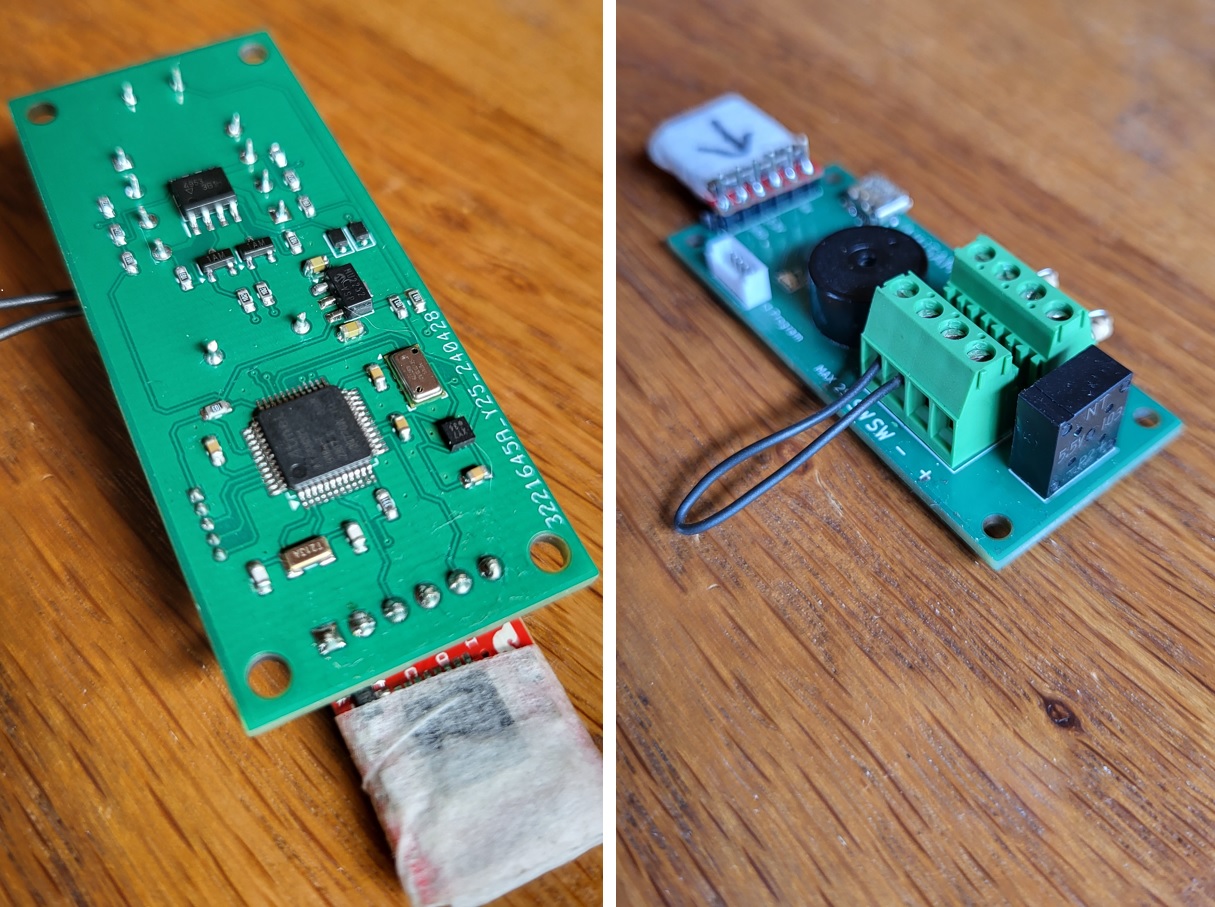
To overcome these problems with the RDAS, a new flight computer was designed that also uses acceleration to determine apogee. For this, the modern KX134 accelerometer was used, capable of measuring up to 64G’s in three axes. Deployment of the main parachute at lower altitudes is determined by barometric altitude measurement using a MS5611 barometric sensor. To facilitate easy data transfer, the board is equipped with a Openlog (Sparkfun) SD card logger. Testing of the new flight computer will start this summer.